Vipassana Meditation
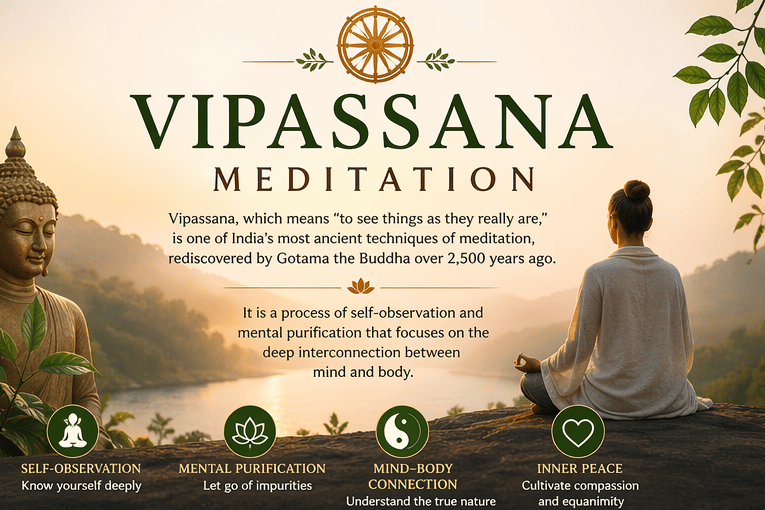
Vipassana, which means "to see things as they really are," is one of India's most ancient techniques of meditation, rediscovered by Gotama the Buddha over 2,500 years ago. It is a process of self-observation and mental purification that focuses on the deep interconnection between mind and body.
4/22/20262 min read
Key Takeaways
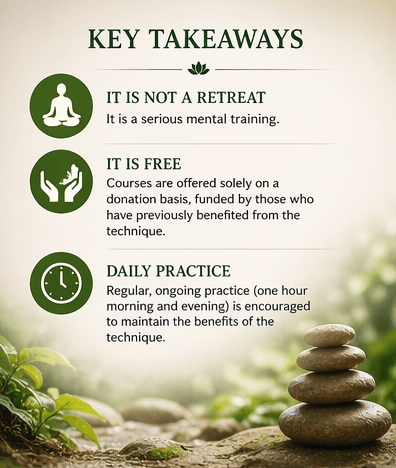
• It is not a retreat: It is a serious mental training.
• It is free: Courses are offered solely on a donation basis, funded by those who have previously benefited from the technique.
• Daily Practice: Regular, ongoing practice (one hour morning and evening) is encouraged to maintain the benefits of the technique.
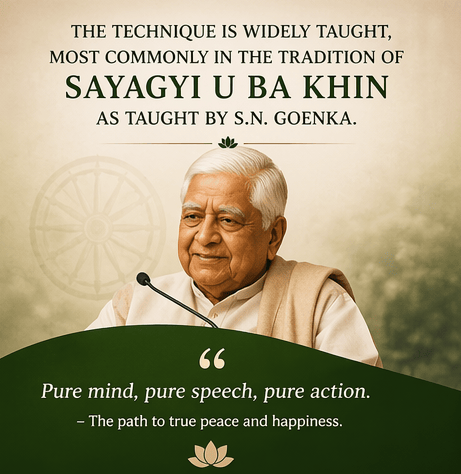
The technique is widely taught, most commonly in the tradition of Sayagyi U Ba Khin as taught by S.N. Goenka.
Vipassana, which means "to see things as they really are," is one of India's most ancient techniques of meditation, rediscovered by Gotama the Buddha over 2,500 years ago. It is a process of self-observation and mental purification that focuses on the deep interconnection between mind and body.
This profound connection is experienced directly by paying disciplined attention to the physical sensations constantly occurring within the body. By objectively observing these sensations without reacting to them, practitioners gradually dismantle deeply ingrained habits of craving and aversion. The technique is traditionally taught through rigorous ten-day residential courses that require a strict commitment to noble silence. As a strictly non-sectarian practice, it aims for the total eradication of mental impurities rather than converting individuals to a specific religion. Ultimately, this continuous inward journey results in the highest spiritual goal of full liberation, fostering a life of profound peace and genuine compassion.
Brief overview of the key aspects of Vipassana meditation
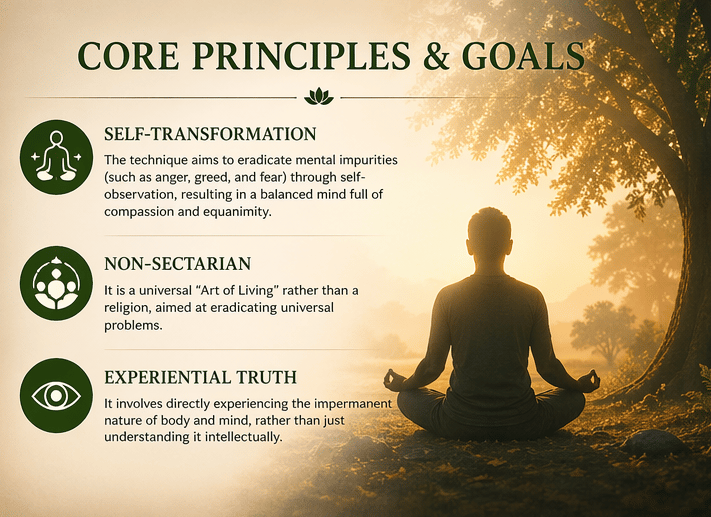
Core Principles & Goals
• Self-Transformation:
The technique aims to eradicate mental impurities (such as anger, greed, and fear) through self-observation, resulting in a balanced mind full of compassion and equanimity.
• Non-Sectarian:
It is a universal "Art of Living" rather than a religion, aimed at eradicating universal problems.
• Experiential Truth:
It involves directly experiencing the impermanent nature of body and mind, rather than just understanding it intellectually.
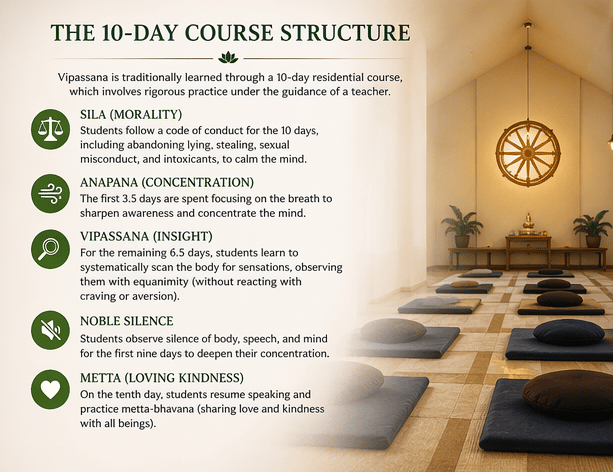
The 10-Day Course Structure
Vipassana is traditionally learned through a 10-day residential course, which involves rigorous practice under the guidance of a teacher:
Vridhamma.org
• Sila (Morality):
Students follow a code of conduct for the 10 days, including abandoning lying, stealing, sexual misconduct, and intoxicants, to calm the mind.
• Anapana (Concentration):
The first 3.5 days are spent focusing on the breath to sharpen awareness and concentrate the mind.
• Vipassana (Insight):
For the remaining 6.5 days, students learn to systematically scan the body for sensations, observing them with equanimity (without reacting with craving or aversion).
• Noble Silence:
Students observe silence of body, speech, and mind for the first nine days to deepen their concentration.
• Metta (Loving Kindness):
On the tenth day, students resume speaking and practice metta-bhavana (sharing love and kindness with all beings).